
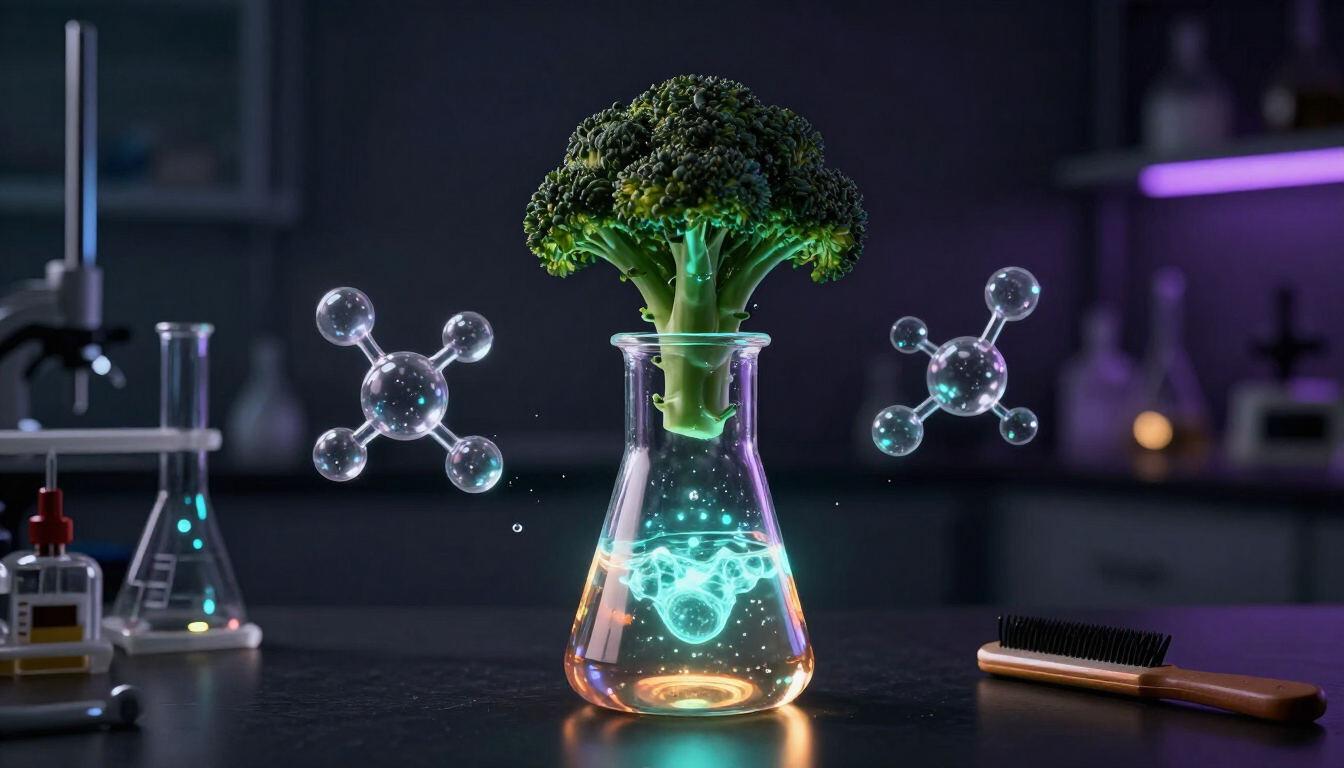
A copper peptide, an AI assistant, and a perfectly reasonable question about regenerative medicine that ended in posterior agriculture and a new product called Buttlocks.
I've been looking into GHK-Cu, a copper peptide that's been attracting attention for its potential regenerative properties. It supposedly encourages collagen production, supports tissue repair, and may even help stimulate hair follicles. Naturally, I started wondering how far we could take this.
GHK-Cu is interesting because it's already found in the human body. It was first identified in human plasma in the 1970s by biochemist Loren Pickart, who was investigating why blood from younger people seemed to have certain rejuvenating effects on older cells.
I suggested that perhaps he'd discovered it while eating children. Gibbet, my AI assistant, informed me that this was not the case, although it acknowledged the considerable scientific advantages of having a ready supply of youthful plasma. Apparently, the institutional review board had concerns.
Anyway, the peptide is thought to influence several processes involved in tissue repair, including collagen remodeling, inflammation, and cellular signaling. Some laboratory studies have also suggested that copper peptides could influence hair follicle activity.
Which brings me to my beard.
I occasionally get alopecia areata, particularly when I'm stressed. It leaves a couple of bald patches in my beard. I've dealt with it before, and the hair eventually comes back. I'm not particularly concerned about it, but if there's something that could encourage the follicles to get back to work a little sooner, I'm interested.
It occurred to me that a combination of hyaluronic acid, minoxidil, and GHK-Cu might be worth investigating. The hyaluronic acid would help with hydration, the minoxidil could encourage hair growth, and the GHK-Cu might provide some additional support for the follicles.
Gibbet explained that there isn't much evidence for GHK-Cu treating autoimmune alopecia specifically, which is fair enough. Then it informed me that hair follicles affected by alopecia areata aren't necessarily dead and can eventually grow hair again.
I already knew this. I've had the condition for years.
Nevertheless, I appreciated the impromptu lecture on the fascinating discovery that hair grows.
The conversation then turned to corticosteroids, which can suppress the immune response responsible for alopecia areata. I asked whether veterinary suppliers carried them. Apparently, they do, although Gibbet was less enthusiastic about my obtaining dermatological treatments from the same people who supply medication for horses.
I'm not interested enough in two missing patches of beard to schedule a medical appointment, so I returned to considering the copper peptide.
That's when things got interesting.
Earlier, I'd asked whether GHK-Cu might be useful for repairing tissues around the anus. Given its alleged regenerative properties, it didn't seem like an entirely unreasonable biological question. Skin is skin, after all, although the rectum has its own rather particular requirements.
Gibbet explained that there wasn't any meaningful clinical evidence supporting rectal applications of copper peptides. It also raised the possibility of irritation and unpredictable absorption.
Then we got onto the subject of new hair follicles.
Could GHK-Cu actually cause new follicles to form? Not merely reactivate existing ones, but generate entirely new follicles in previously hairless tissue?
Apparently, there's no convincing evidence of that in humans. Existing follicles might become more active or produce thicker hairs, but follicular neogenesis is another matter.
Naturally, this led to the possibility of butt beards.
For those unfamiliar with the concept, a butt beard is exactly what it sounds like. A thick, luxurious growth of hair extending from the posterior, perhaps suitable for braiding or the occasional application of beard oil. I can imagine an entire grooming industry developing around it. Specialized combs, conditioners, and miniature barber chairs would be required.
Gibbet proposed a product called Buttlocks, which I thought was a reasonably respectable name for the emerging market. It would be a natural progression from the man bun, although perhaps a little more difficult to display in public.
Then I remembered something else.
A doctor had apparently claimed that GHK-Cu was good for broccoli.
Now, I don't know exactly what he meant by that, and I haven't independently verified the claim. It's entirely possible that I misunderstood something. But given the direction of our conversation, there seemed to be only one reasonable interpretation.
GHK-Cu makes you grow broccoli from your butt.
This represents a significant development in regenerative medicine. Not only could we potentially grow new tissue, but we might also produce fresh vegetables directly from the human body. Think of the agricultural possibilities. Entire communities could become self-sufficient without the inconvenience of cultivating land.
The economic consequences would be substantial. Grocery stores would need to rethink their produce departments, while the Department of Agriculture would presumably establish new inspection procedures. Farmers might object, but they'd have to acknowledge the remarkable efficiency of a crop that grows without soil, fertilizer, or even sunlight.
There would, of course, be certain practical considerations. Harvesting would require some care, and I suspect public health officials would object to selling the resulting produce without appropriate labeling.
I'm not sure I'd want to eat it myself.
The marketing practically writes itself.
BUTT BROCCOLI™
Fresh from the source.
There may even be opportunities for selective breeding. If copper peptides can stimulate hair follicles and broccoli production simultaneously, perhaps we could eventually develop a hybrid crop with particularly attractive florets. Cauliflower would be a logical next step, followed by Brussels sprouts.
I've been informed that none of this is supported by clinical evidence, which seems like precisely the sort of closed-minded thinking that has held back posterior agriculture for centuries.
For now, I'll probably stick with the more conventional application of GHK-Cu to my beard. Its effectiveness for alopecia areata remains uncertain, but at least there's a plausible biological mechanism worth investigating.
As for growing broccoli from my backside, I think we’re going to need additional research.
Preferably involving someone else’s ass.
—Robert
Orbit 88.7: Smooth Waves for Rough Space