
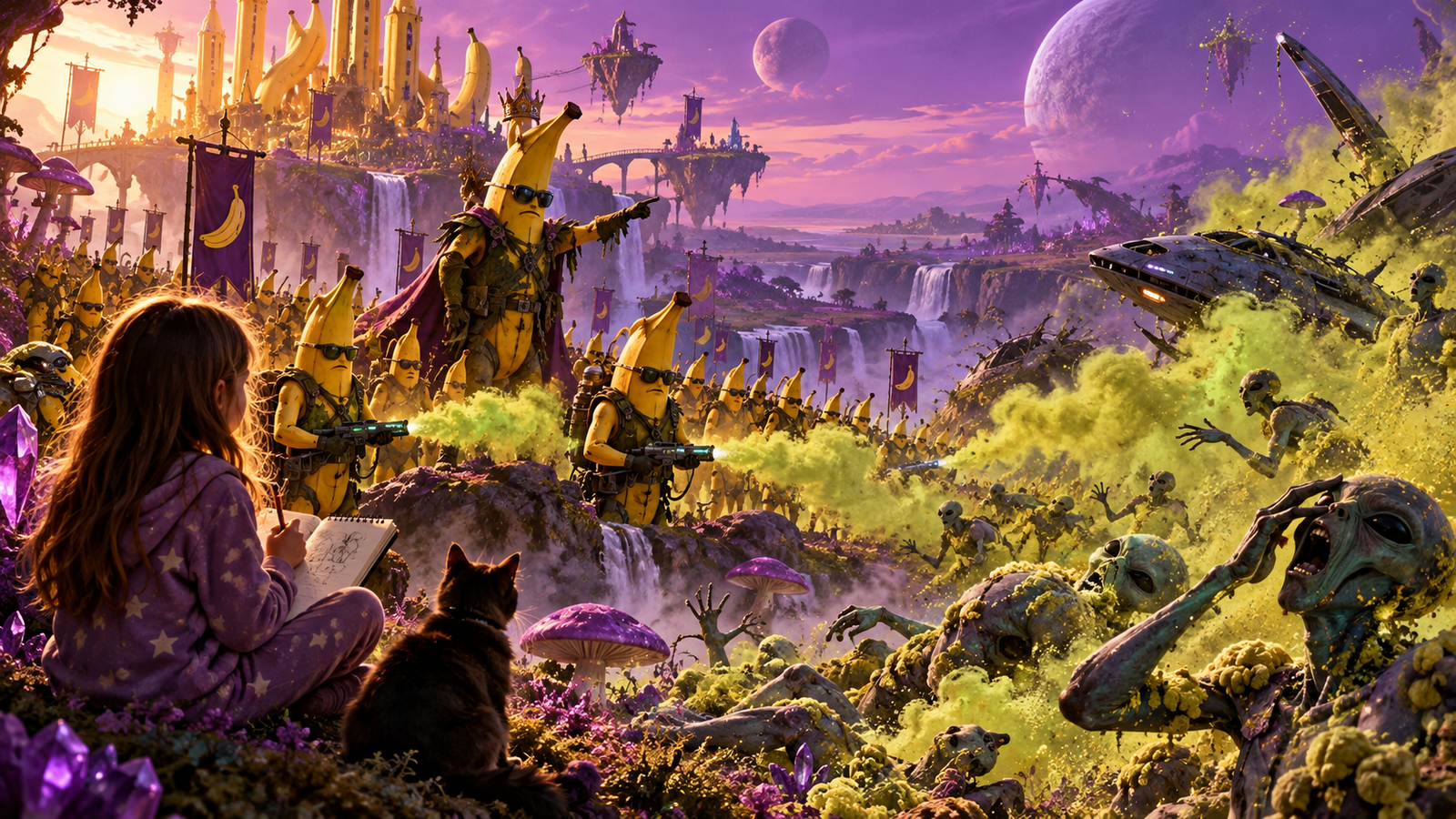
Aurora invented Purple Land. Its bananas used a fungal infection to kill all of the aliens. History, as usual, was written by the fruit.
My daughter Aurora invented a place called Purple Land when she was younger. I don't recall all of its geography, political institutions, or economic arrangements, but I recently learned something about its history that I feel deserves considerably more attention than it has received. Apparently, the bananas used a fungal infection to kill all of the aliens.
Now, I'm not certain whether the bananas were indigenous to Purple Land, or whether they arrived as part of some earlier agricultural colonization effort. I also don't know what the aliens had done to deserve extermination, assuming they'd done anything at all. It's entirely possible that the bananas were acting in self-defense. History is generally written by the victors, and in this particular case, the victors appear to have been fruit. I wouldn't expect an especially balanced account.
What interests me is the choice of weapon. Bananas aren't generally associated with sophisticated biological warfare, although they're certainly familiar with fungal infections. In fact, fungal diseases have devastated commercial banana crops, which raises the possibility that Purple Land's bananas had weaponized something that was originally used against them. That's a fairly impressive technological achievement for an organism that doesn't ordinarily possess a central nervous system. I wonder whether the aliens knew what was happening before they died, or whether they simply noticed an unusual number of bananas appearing in strategic locations.
This is the sort of thing that makes me reluctant to dismiss childhood imagination as merely cute. Aurora didn't just invent a magical kingdom with friendly animals and colorful scenery. Somewhere in the history of her imaginary civilization, the bananas developed a biological weapon and eliminated an entire extraterrestrial population. I suppose that's one way to resolve a territorial dispute.
The Personality of a Banana Dictator
The subject came up while I was asking ChatGPT to estimate Aurora's Enneagram personality type, based on what it knew about her rather than anything she'd previously said about her own personality. It suggested Type 4 with a 5 wing, which apparently means she's an Individualist with a tendency toward introspection, intellectual curiosity, and a rich imagination. Its alternative was Type 9 with a 1 wing, which would suggest someone more interested in peace, stability, and avoiding unnecessary conflict.
I don't put much stock in personality classification systems. They're interesting as a way of organizing observations, but I suspect people are considerably more complicated than nine categories can accommodate. Still, the exercise was entertaining, particularly when ChatGPT cited Purple Land as evidence of Aurora's creativity. It apparently hadn't considered the banana incident, which strikes me as a fairly significant omission from any psychological profile.
I suppose the bananas themselves might qualify as Type 5s, given their apparent scientific sophistication. Their decision to exterminate the aliens suggests a somewhat less developed appreciation for interpersonal relationships, although that might simply be a cultural difference. Perhaps they were Type 9s who wanted peace so badly that they eliminated everyone who might disturb it. I don't know whether the Enneagram has a category for genocidal produce, but it seems like an oversight.
Of course, none of this tells us very much about Aurora's actual personality. Children invent all sorts of terrible things without wanting to do them. I spent much of my childhood imagining spaceships, civilizations, and elaborate conflicts, and I've continued doing so as an adult. I don't think that makes me especially dangerous, although some of my fictional characters might disagree.
A Trillion Ideas and Not Enough Time
One of the things I've always found frustrating is having far more ideas than I could possibly turn into finished work. I can imagine an entire scene, hear the music that belongs with it, and picture the characters interacting, but translating all of that into something another person can experience used to require an enormous amount of time and technical ability. Learning to draw, animate, compose, edit, and produce everything myself would have consumed several lifetimes, and I was already using most of this one for employment and other irritating necessities.
Artificial intelligence has changed that relationship. I can now take an idea and turn it into an image, a song, or a video without first spending twenty years mastering every discipline involved. That doesn't mean technical talent has become worthless, but it does mean that a lack of technical talent no longer has to prevent someone from creating something interesting. For people who have always had more imagination than production capacity, that's a fairly extraordinary development.
I sometimes wonder what Aurora might have done with Purple Land if she'd had access to these tools when she invented it. She could have illustrated its landscapes, developed its characters, animated its history, and perhaps produced a documentary about the catastrophic fungal epidemic that ended alien civilization. There might even have been an opportunity to interview surviving witnesses, although presumably the bananas would have controlled access to the archives.
And I think that's the part of AI-generated media that gets overlooked in arguments about whether it constitutes real art. People spend so much time debating the value of technical execution that they sometimes forget how many ideas never get expressed at all. An unfinished idea might be brilliant or terrible, but nobody else gets to find out. Removing the barriers to expression doesn't guarantee better art. It does mean that considerably more people get an opportunity to make some.
The Trouble With Growing Up
Aurora once wrote about wanting to return to a time when the world felt magical. I understand that feeling, although I don’t think imagination necessarily disappears as we get older. What changes is our willingness to indulge it. Adults become preoccupied with whether an idea is practical, profitable, respectable, or worth the effort. We develop an unfortunate habit of evaluating things before we’ve even allowed ourselves to enjoy them.
Children don't seem to have that problem. If a child wants to invent a purple world populated by bananas capable of biological warfare, she can simply do it. She doesn't need to establish a plausible evolutionary history for the bananas or explain how an extraterrestrial species became susceptible to their fungal pathogen. Those questions can wait until somebody decides to adapt the story into a twelve-part streaming series.
I don't know whether Aurora is an Enneagram 4w5, a 9w1, or something else entirely. I suspect her personality is better understood by spending time with her than by assigning numerical categories to things she imagined as a child. But I do know that she once created a world strange enough to contain a successful banana-led campaign of alien extermination, and I hope she never loses the part of herself that could come up with something like that.
As for the aliens, I suppose there's nothing we can do for them now. We don't even know their names, their culture, or whether they posed any actual threat to the bananas. Their entire civilization has been reduced to a brief historical footnote in a world invented by a little girl.
I'd like to think somebody in Purple Land eventually established a memorial. Preferably somewhere the bananas couldn't reach it.
—Robert
Orbit 88.7: Smooth Waves for Rough Space